In November 2004 I attended my first ever away trip to watch England as part of the official travel group. The trip was to the famous Estadio Bernabau for a relative meaningless friendly. The whole trip was a disaster, ranging from a four hour delay on the way out, the appalling treatment dished out to the traveling fans in the stadium by the Spanish police and of course the appalling racial abuse that the sparse crowd on the night gave to some of the England players. In the run up to the match comments made by the then Spanish coach Luis Aragones to members of his squad about Thierry Henry hit the headlines as he was fined a paltry around a day’s wages for his racial outburst by the Spanish FA.

The game itself wasn’t too impressive as a solitary goal by ex-Chelsea full back Del Horno in the first half settled the game. Obviously being my first ever away trip I expected a little bit more. Tickets cost something stupid like €4 each to try and generate some interest from the locals in Madrid for basically a game that no one really wanted to watch. There was some interest from the England fans as it was a new venue to tick off. One of the other abiding memories was the fact it was a freezing cold day and night but the huge powerful heaters in the top tier of the stadium meant it wasn’t long before fans were stripping off.
Since that game England surprisingly announced a return fixture two years later in Manchester in what turned out to be the last international played away from Wembley Stadium when Iniesta scored the only goal of a dull game under the leadership of McClown. So it was some surprise that initially rumours started that we would play them again so swiftly, and secondly where we would play as the Spanish FA initially would not be budged on Madrid as the venue.
Most fans worked on rumour and gossip for these games and this means taking a risk on flights before they get too expensive. I had heard a whisper of four potential venues in late 2008 – Valencia, Alicante, Santandar and Seville. Basing my logic on the fact that three places were in the south I booked flights to Alicante for a royal sum of £45. Of course the day I actually got round to do the booking the FA announced that the game was being played in Seville. Ryanair, after keeping me on a 10pence per minute music on hold line for 17 minutes told me the flights were non refundable but for £25 per leg I could change them….so for £50 I could change my £45 flights. Real logic there so instead I made a call to Dagenham Dan and within ten minutes we were booked on an early flight to Madrid and then the ridiculous fast train down to Seville.
I’ve never experienced this way of travel before. These trains put Eurostar to shame and travel at over 300km per hour on average – completing the 500 mile journey in under 2 1/2 hours. AND if the train is more than 5 minutes late you get money back!
There are three stadiums in Seville and it was odds on that it would be played initially at the Olympic Stadium. It was here that Celtic lost to Porto in the UEFA Cup final of 2003 in the 100+ degree heat that always seems to characterise the city. I was part of a group of ten which managed to all get tickets by applying earlier enough on the UEFA Cup website and then laughed our socks off as Celtic fans who could have had faith in their team and booked them the same way as us could not get any. I do not understand this logic. If tickets are available openly to the general public and your team could be in the final, why wouldn’t you take a chance. The Olympic stadium has never hosted any Olympic event and so I have no idea why it is called so, but it is a white elephant amongst a city that is know for its white elephants. The stadium is in the northern areas of the city, with no facilities or public transport links close by. We walked for 45 minutes across wasteland to reach the stadium on that May night and since then the stadium hasn’t hosted another big event. For this game the Spanish FA decided to play at the Ramon Sanchez Pizjuan, home of Sevilla and a real favourite with the national team who had not lost a game in their long history.
The stadium is located to the east of the city centre, and was almost across the road from the hotel I had booked – for once a bit of inside knoweldge was useful for this trip. Apart from the 2003 trip I had been to Seville on two occasions, and both times had stayed at the Hesperia. On both instances it proved an oasis of cool on days where the mid day temperature soared over 100 degrees. Sevillians cope quite well with the heat – as they simply go home for lunch and sleep (Siesta time) for 3 hours. Us English instead did what English people do best in the mid day sun…we drank beer and wandered around a theme park!
So at 5pm on a freezing cold Wednesday morning I set off from chez Fuller, picking Dan up enroute to my second home Stansted. Within two hours of leaving the artic conditions of south east England we were touching down in a very sunny and warm Madrid. We had a couple of hours in the capital before our 3pm train down to Seville so we headed for a restaurant in the main station, Atoche, which looked more like a botanical garden than a station. We had a choice of restaurants and so picked the one that had the best looking clientele of course! We ordered – a typical Spanish meal of Spaghetti Carbonara for moi and fried chicken for Dan. Within 10 seconds, no word of a lie, my meal turned up. About a minute later the waitress came back with our drinks and looked puzzled. For a few seconds she was tempted to take away my meal which was obviously intended for someone else! I should add at this point that the reason for my strange choice of food was a growing pain I had in my upper jaw behind one of my teeth. I initially decided to concentrate on alcohol as a pain killer but that soon proved to be a bad move.
Our train, unsurprisingly left on the dot of 3pm and less than two hours ten minutes later, after covering close to 600km we pulled into an even sunnier and hotter Seville Santa Justa stadium. Rob the Red was there to meet us and we swiftly joined by Shents who had been in Malaga the previous evening watching our under 21’s play Ecuador. It appeared that the mindless element of the England fans had been out in full force in the centre of Seville, thinking that throwing oranges, pulled from the trees, at passing locals was a “great weeze”. Unsurprisingly the riot police, not shy in coming forward, had broken up the crowds in the, surprise, surprise, Irish bar as well as smashing a few tourists cameras who had attempted to film the whole thing.
After a brief pit stop at the hotel we met up with our usual travelling party for another typical Spanish meal, Pizza Hut which proved more than I could chew quite literally as the pain in my jaw was almost unbearable and for a brief moment I contemplated giving the game a miss and heading back to the hotel. We had been told to get to the stadium early, in fact as early as two hours before kick off, based on the treatment we had received in Madrid. So we turned up at the ground at 8pm and waited. And waited, and the waited some more. Eventually at 8.50pm we were let in and headed for a decent spot in the stadium.
Spain 2 England 0 – Stadium Ramon Sanchez Pizjuan – Wednesday 11th February 2009











About the Ramón Sánchez Pizjuán
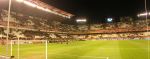
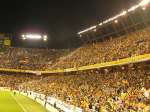
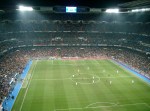
The Ramón Sánchez Pizjuán is still one of the most atmospheric stadiums in Spain. It was originally opened in 1957, replacing Seville’s original home, the Estadio Nervion that was located close by the current ground. At its peak the stadium held over 60,000 but today due to safety issues and the conversion to all seater it has been reduced to just over 50,000. It is a relative simple stadium – a two tiered bowl structure, with steep sides and only one stand covered. The stadium hosted the 1986 European Cup Final between Barcelona and Steaua Bucharest as well as hosting games in the 1982 World Cup finals including the infamous Semi-Final between West Germany and France. After the 1982 World Cup, the land that the club owned around the stadium was sold for development and today it is indeed a strange sight that it is quite hard to find the stadium as a whole shopping and residential complex has been built around it.
The stadium is also used frequently for the national team, and is deemed a lucky omen in that they have never lost here in over 20 games. Added to this is the remarkable record Sevilla have in European competition in that they have never lost an European tie at home – a fact that certainly ensured UEFA Cup success last season. Average attendances over recent seasons have been over 40,000 but success on the field this season has seen it rise to nearly 50,000.
How to get to the Ramón Sánchez Pizjuán
The stadium is located to the east of the city centre, within a 5 minute walk from the Santa Justa railway station – the terminus for the AVE trains from Madrid, and forms part of the From the city centre buses C1, C2, 32 and 37 run from the city centre.
If the club switch a game to the Estadio La Cartuja in the north west of the city, then be prepared for a long 30-minute walk from the historic city centre. The renamed Olympic Stadium sits on the old Exp site north of the Ronda de Circunvalacion ring road, and whilst is an impressive stadium from the inside, suffers badly from being so isolated.
How to get a ticket for the Ramón Sánchez Pizjuán
Despite Seville’s meteoric rise to fame over the past two seasons, tickets for most games (Betis, Real Madrid and Barcelona excepted) are easy to come by. The ticket office will start selling them from around 10 days before the match, with prices starting from €30 for a place in the Gol Sur or Norte to €90 for a covered seat in the Preferencia Banco de Pista. During May and September, temperatures in Seville can still hit the high 30’s and so it is worth investing more to get one of the limited tickets in the shade, rather than risk sunstroke.
For the big games, tickets are severely restricted but still available. For instance, for the Seville derby versus Betis, tickets were still on sale two days before the game – although prices tend to be inflated by around 40% for these fixtures. Last season Seville averaged just over 40,000 for their home fixtures.
If Seville, for any reason, switch their home games to the Olympic Stadium (more commonly known as the Estadio La Cartuja) then tickets are still sold via the ticket office at the Ramón Sánchez Pizjuán. A couple of seasons ago, the club experimented by playing a couple of games here but crowds actually fell and so they are in no hurry to repeat the experiment.
Around the Ramón Sánchez Pizjuán
The stadium is located in the middle of a shopping centre, which makes it hard to see from the surrounding roads, but means that food and drink outlets are numerous around the stadium.
 The Ball is Round
Leave a comment